

I’m Emily Grabatin, and this Welcoming Slow Growth Podcast is a space for God led writers, entrepreneurs, and creatives called to bring hope and healing through your work. This season, we’re exploring stories of like-hearted people who chose a word or phrase to guide who they’re becoming…and what happened in the process.
Let’s settle in together.
Here’s an adaptation of a conversation with artist Jeremy Wells on daily bread, honest art, and what changed the trajectory of his life and art. (Listen to the full conversation above.)
Have you ever felt like your creativity doesn’t quite fit inside church walls or the expectation of the world that you’re in?
Like everything you make is supposed to sound a certain way or look a certain way or be a certain way, and that doesn’t quite fit what’s on your heart. Or maybe you’re trying hard to find your edge into the creative world, and you think it’s supposed to happen a certain way.
Today’s guest grew up with those exact tensions. Now he has a whole new understanding of what it means to make honest kingdom-minded work. Artist Jeremy Wells shares some profound experiences that help shape that perspective.
Who you are isn’t what you do
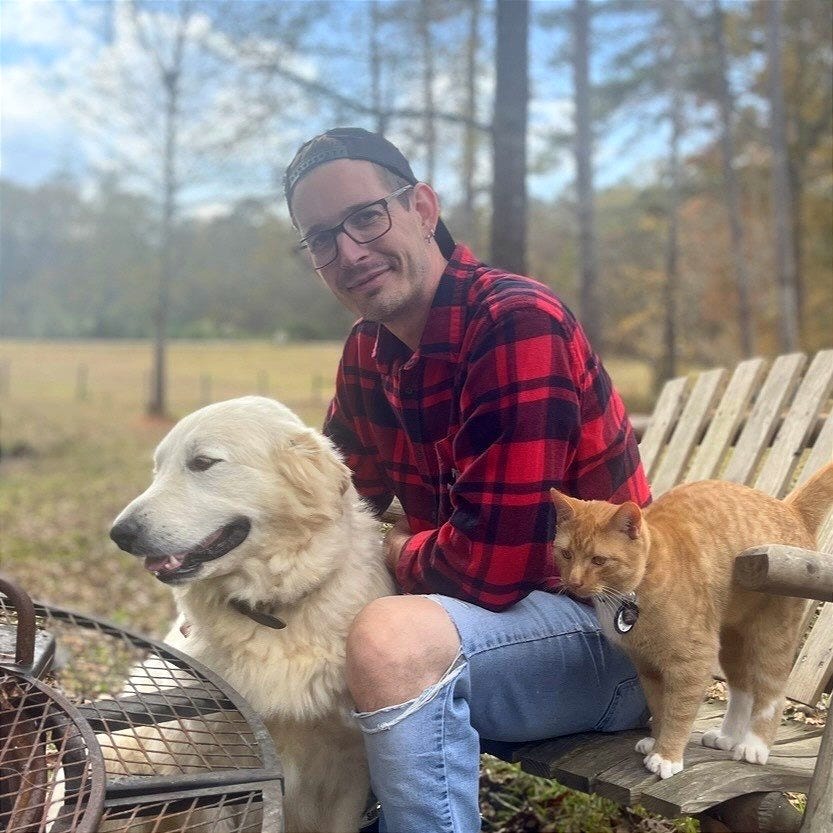
I introduced Jeremy Wells with the brief bio he gave me: “Loving cat dad to Ziggy and Nutmeg, collector of cassette tapes and CDs. (You’ll have to explain those later.) Illustrator of nonsense and enthusiast of all things nerdy.”
Then I added, “So Jeremy, tell us what you really do.”
He laughed, then said something wise that caught me off guard. “ I heard once before from a friend of mine who said, ‘If someone asks you what you do, talk about who you are in—instead of your job.’ So I try to lead with that, ‘cause my job isn’t really who I am, though it does pay the bills and it’s opened up a lot of doors for me.
But that bio’s pretty accurate. I’m a dork, in every sense of the word, lovingly so.
A nerd for physical media, whether it’s movies, music.
I love things that are tangible. The feel of a pen in my hand, paper that’s rough or smooth, whatever, I try to take it in. I see the world through my hands- a visual artist. So that’s truly who I am.
Yes, Ziggy and Nutmeg, my two cats, they’re, they’re my world. But I work as an artist, to pay the bills.”
Jeremy described a number of commercial jobs, such as murals and illustrations, he’d done in the past in the past, but his day-to-day work is for Trader Joe’s as a sign artist. He started there in January 2011 shortly after moving to Columbus, Ohio, and it quite accidently became his introduction to the world of commercial art.
“I was just looking for whatever job to kind of bridge the gap in my transition. I was looking to get away from some things that I had done for years past, and, I just filled out a paper application, took it in one day knowing that Trader Joe’s a cool company, it’s laid back.”
A couple days later he got a phone call from a manager at Trader Joe’s asking if the penmanship on his application was actually his or if he had somebody else write it for him.
“I was kinda confused ‘cause that’s how this individual led the conversation. ‘Yeah, that’s me.’ I’m not passing that off to somebody else. I didn’t say that, but that’s what I was thinking.
He asked if I could come in for an interview for a sign artist position. Something that I didn’t even know Trader Joe’s did. They hire full-time sign artists, people to create chalkboards and murals and, and just product placements internally in their stores.
I was kind of shocked. I didn’t have a portfolio, and I was scared to death to go into an interview for an art position that I had absolutely nothing to show for. At that point, I had gone nearly seven years without creating much art at all. I would try to sketch here and there, get nowhere, and I would stop, and months and months would go by without the slightest bit of art output.
So I went to my interview and met with the gentleman. The interview lasted all of five minutes. No joke.
We walked over to a Starbucks, sat down, and he said that, when he met me in the store, ‘His Spidey sense was tingling.’ And he just wanted to see if I was a cool guy. And I was like, “Oh, okay. Cool. Yep, what you see is what you get.”
He had my application with him, and then again he reiterated, ‘This is your penmanship, right?’
And I said, “Well, yeah, it is. I don’t have a portfolio for you, though.”
But he pointed to my application and said, “This is the best portfolio you could have brought.’”
Jeremy was hired on the spot and has been a professional artist in one way or another ever since, with a gap of a few years where he tried his hand at farming. A few years ago, he returned to Trader Joe’s as well as stepped into some brand new art ventures, rebuilding from the ground up to make art that has been on his mind for years.
“I got into art as a profession quite accidentally. But I’ve never quite been able to let it go. It always brings me right back in, even when I’ve stepped out. And, quite frankly, there’s nowhere else I’d rather be.
I need to create.”
Life often doesn’t go the way we plan but its curveballs do shape us along the way, and Jeremy shared some of those experiences.
The kid with two lunchboxes
Jeremy’s earliest memories are of drawing. Not dabbling but drawing with the kind of focused devotion that only children and artists understand.
He carried two lunchboxes to school. One for lunch. One for art supplies.
He grew up in Texas, the son of a Southern Baptist pastor — and if you know anything about that particular strain of 1980s conservative Christianity, you can probably fill in some of the gaps. Rules. Structure. A very clear sense of what was acceptable and what wasn’t.
Art, it turned out, occupied a confusing middle ground.
Jeremy wanted to draw everything, the world and the people in it. Except he wasn’t a fan of the stick figures his peers were drawing. He wanted to draw the way things actually looked.
Then came the crushing moment. In second grade, Jeremy drew a portrait of his mother. Full dress, long hair, anatomically considered the best he could manage at that age. He was proud of it. He thought he’d done something good.
He was punished for it. In fact he was told he should never draw filth like that again.
“So then I’m thinking — but this is real. There was nothing gratuitous about it. I drew a picture of my mom.”
But the world, he was taught, was something to be wary of. And his creativity — a part of who he was — needed to be either monetized or sanctified to be considered worthwhile.
What do you do with a creativity that keeps getting told it’s too much, too real, too… something? For Jeremy, the answer eventually became: you stop.
Seven years of wandering without creating
By the time Jeremy was nineteen, the pendulum of his childhood had swung so many times — strict to permissive to stricter again — that he’d stopped trusting any of it. The faith. The rules. The adults who kept changing the terms. He’d finished school early, taken a Greyhound bus across the country at fifteen, and spent years just trying to find solid footing.
His art and creative output got lost along the way. .
Nearly seven years passed without any meaningful art output. He’d try to sketch, get nowhere, and stop. Months would go by. Then more months.
“Nothing in the world was satisfying. I was very much going through the motions.”
It wasn’t creative block in the way we usually talk about it — the kind that comes from perfectionism or fear of the blank page. It came from a deeper place. A disconnection from self, from God, from the part of him that needed to create in order to feel whole.
And then, quite by accident (or maybe God’s providence), that door at Trader Joe’s opened.
“ I got into Trader Joe’s and decided, ‘You know what? Life hasn’t been too kind. I should probably go to counseling.’ I had kind of an epiphany of sorts and started counseling, and that was a kindness to say the least.
One of the most difficult experiences of my life turned into a brand new trajectory where I finally felt whole, or at least in a direction of wholeness… Just learning what it meant to be me, who God had made, and more importantly, who God actually was…
I had always seen Jesus as a fist, and I finally saw an open hand.
And, that turned my life around. It changed every trajectory in my life, my heart, my thoughts, and my art.”
Daily bread
While Jeremy doesn’t have a ‘word of the year’, there is one phrase and word picture that has been a guiding presence for him the last several years.
Daily bread.
It started, unexpectedly yet not so surprisingly, with communion.
In his early twenties, still carrying the residue of his Southern Baptist upbringing, Jeremy was invited to a non-denominational church. He went, found it warm and welcoming, and at the end of the service they had communion.
I thought, “Oh, dang, I came on the right service ‘cause, communion only happens once a quarter”. So I have communion, and I leave.
He came back the following week and they have communion again.
“‘Like, whoa. Okay. These guys are a little crazy. All right.’ But I couldn’t process communion two weeks in a row. My, my Southern Baptist sensibilities said, That’s not right. But I guess I’ll do this. As wild as that sounds, I was taught that it’s so special that if we did it every week, it would lose its meaning.”
He went back a third time. They did communion again.
“Now I was mad. I thought — this church just has it all wrong.
So I left, and instead of just stewing, I just went right to the Bible. There was a part of me that wanted to have this gotcha moment where I could just be like, “Look, you guys are doing this all wrong.”
Instead, he found Jesus simply said, “As often as you do this, do it in remembrance of me.”
That was it. No restrictions. No measured grace.
That moment broke something open in Jeremy. He choked up as he described his revelation to me. “I was completely wrong in how I saw Jesus. I never met Him the way He truly was.”
He stopped being defensive and became, as he put it, a sponge.
What else did I get wrong? Teach me.
And the more he read, the more he got to know a Jesus who wept, who stopped, who noticed.
“Jesus wept… It’s a compassionate Jesus, but why is He compassionate?
He’s compassionate because He wants to see us be made whole. I think that we’ve got it all wrong when we think of things like the Beatitudes and what it means to be blessed, or the Lord’s Prayer and what it means to seek after that daily bread.
Because when you dig into it, to be blessed is to be at peace. It’s not to be lavished with all kinds of things. It’s to be at peace in the midst of all things, and to have that daily bread every day. Yes, it’s to be taken care of. It’s to have the roof over our head, the food on our table, the clothes on our backs. But it’s also, Lord, quiet my tongue when I’m angry.
Can I see You in someone else and quiet my tongue?
Or when I’m walking and I see the birds, can you place it on my heart to stop and take this in? ‘Cause it’s beautiful, and I don’t wanna miss it.
It’s being present. It’s being in this conversation that we’re having right now. To be open and honest and creating relationships that last and make a difference. I think all of this is daily bread.”
Daily Bread for the Creative Soul (and what makes real “Christian art”)
Jeremy’s understanding of daily bread expanded beyond the financial, beyond the merely practical, into something that encompassed the whole person. He takes it even a step further.
“I think daily bread is creativity because I want my life to be an outpouring of what’s been done for me.
God, every day, give us this day our daily bread.
Give me something to see, something to hear that fills me with joy in the midst of all that’s going wrong.
Give me someone to be compassionate to.
Fill my mind with good things throughout the day, regardless of the circumstances.
And since I’m an artist, may I process this and put it back into the world to show someone else something beautiful.”
Jeremy’s words are spilling from him. There’s no denying his conviction on how a daily bread mindset can shape a kingdom-minded approach how we create and offer it to those around us.
“When people talk about “Christian art,” a lot of us think of Thomas Kinkade and things like that, but I think it goes so much deeper.
If I sketch a silly picture, a doodle, and I show it to a kid and that kid is thrilled, I just made the best Christian art of my day, ‘cause I connected with this child and I used God’s gifts to do it. That’s worth more to me than any painting or commercial work I’ve ever done.
I love the avenues that God has taken me through and to, but using the skills and the creativity that we have to connect with others—that’s daily bread. That’s part of it.
One of those core human needs we have is that being seen, being heard, being understood. And sometimes words don’t necessarily do that, because we’re feeling something or we are processing what we’re thinking or feeling.
Something that stops you in your tracks or something silly, like a child laughing at your drawing—yeah, that’s a connection moment. I mean, that’s what Jesus did to little kids. Maybe he wasn’t drawing pictures, but the connection was real, right?”
By this time in the conversation, I was captivated by Jeremy’s passion, the undercurrent of stories both shared and unshared, and a beautiful healing transformation I could see had taken place in his journey.
I felt I was witnessing a “holy ground” story. Like Moses from the Bible, an experience when you’ve felt out of place, unseen, even running from past wounds and regrets, and then God catches your attention by revealing himself in a startling way and calls you to a purpose you doubt you’re neither worthy of nor qualified.
Your invitation to create art that connects
Here’s where Jeremy’s story becomes an invitation.
Maybe you inherited some version of what Jeremy grew up with. The idea that the Christian life and art should look a certain way.
Jeremy pointed to Jesus as a carpenter — someone who made things with his hands and, he suspects, simply wanted to make them well. Sturdy. Useful. Good.
“It doesn’t have to be covered in crosses to be Christian art. It just needs to have a kingdom mindset. And the kingdom is the people.”
There’s a connection between art and Jesus, and your wholeness and your healing, and that wanting others to experience that too.
Honest art as a mission
Jeremy’s mission now, as he rebuilds his creative practice from the ground up, is to make art that’s truthful and honest.
Not safe art. Not art that avoids discomfort.
Art that reflects real life — which sometimes means something silly, and sometimes means something that makes people feel things they weren’t expecting to feel. His goal isn’t to be antagonistic or cause trouble, but rather to start a genuine conversation.
He told a story about a piece he made years ago that stirred wildly different responses. One person told him no Christian could have made something like that, that he must be going to hell. Someone else said it was so beautiful it brought him to tears.
Jeremy’s response to both was, I want to talk about it.
“If you see my art and it makes you feel something, you can hate it. It’s okay. But if you can talk to me about why you hate it, I want to know…
That is a lot of what Jesus did. He either asked questions to spur conversation, past assumptions we thought. He made you think about things, and it wasn’t always comfortable. Some people did get mad, and some people were just confused, and they had to wrestle with it.
That posture — curiosity over defensiveness, conversation over performance — is what honesty looks like in practice.
For the creative who wonders where they fit
Before we wrapped up, I asked Jeremy what takeaway he’d want to leave for the writers and creatives listening.
He didn’t hesitate.
“If you’re anything like me, you probably have a lot of insecurities, as well as a tendency toward perfectionism.
We criticize ourselves constantly.
We hold ourselves to an unreasonably high standard. And because of that, we might be apprehensive to put our art out there.”
But here’s what he wants you to hear: the messy conversations, the misunderstandings, the moments where someone sees your work and gets it completely wrong — that’s not failure. That’s participation. That’s what it means to be active in the world.
“If we’re messy, it just means we’re in good company.”
And if you step out in faith — not confidence, not certainty, just faith that God has this under control — you walk through. You end up with a new friend, a new person in your community. You walk away as a participant.
“Be authentic. And get some weirdo friends. That’s the best life.”
The fleeting picture Jeremy mentioned comes to mind often — Jesus as a fist versus Jesus as an open hand. So many of us grew up with the fist version of faith. The one with rules for your art, rules for your calling, rules for what counted as worthy or Christian enough.
And somewhere along the way, maybe you stopped creating or writing, unsure where your work fits.
But Jeremy’s story is proof that the open hand version is real. And it’s patient. And it doesn’t waste a single thing — not even in the wilderness years.
Whatever season you’re in right now, I hope this conversation is a reminder that your creativity doesn’t need to be performance or.
It can daily bread – a way you to experience God’s presence or fulfill someone’s need for connection.
Connect with Jeremy Wells
To follow Jeremy as he build his art portfolio from the ground up or continue a conversation with him, find him on Instagram @twin.kitties.art.studio.
Continue the conversation
What is something from this episode that stood out to you? How is it giving you a perspective you hadn’t considered before?
Your Creative Slow Start
In a slump or creative wilderness, and want to get a writing or creative rhythm going again? Begin your Creative Slow Start with this free 5-day writing (journalling) experience here: emilygrabatin.ca/creativeslowstart/
Mentioned in this episode:
Luke 22:14-20; Luke 19:41; Luke 11:31; Luke 18:15-16
Connect with Emily Grabatin:
Substack | Podcast | Author Tips | Coaching | Book


